Where to Sit in a Meeting Room for Maximum Impact
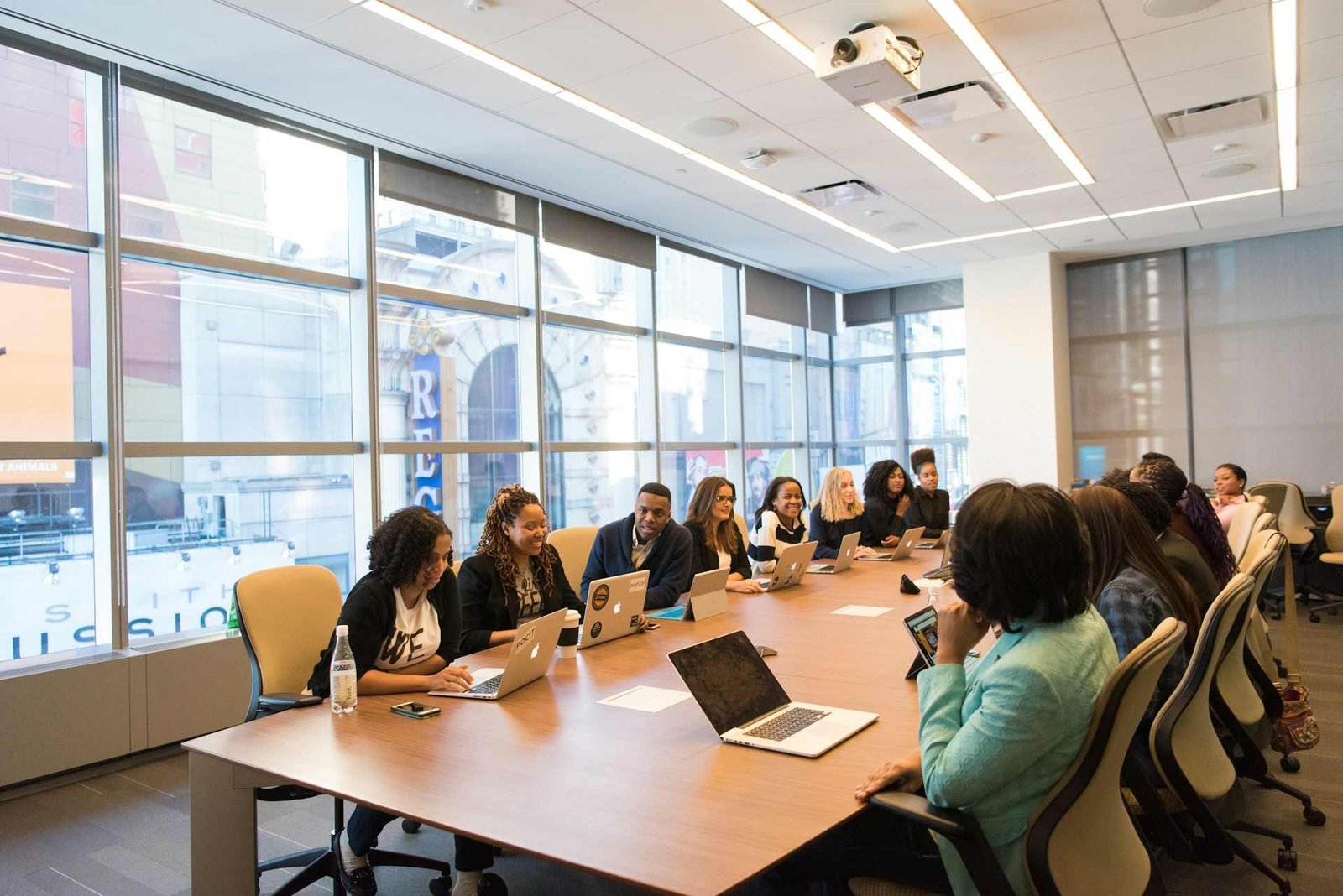
Most of us have shuffled into a conference room, scanned the available chairs, and then picked one based on… proximity to the door? The seat that looked most comfortable? Wherever our eyes landed first? Turns out, that split-second decision carries a lot more weight than we give it credit for. The psychology of where you sit in a room goes deep, and once you know how it works, you’ll never walk into a conference room the same way again. Researchers have been studying meeting seating dynamics since at least the 1960s, and the findings are fascinating.
Why Seating Position Matters
Seating position influences three things that matter in every professional meeting: how much you participate, how others perceive your status, and how much eye contact you naturally get with the decision-makers in the room.
A study by Sommer (1961) found that in groups of four to six people around a rectangular table, leaders consistently emerged from the end positions, not because those people were necessarily more capable, but because those seats gave them visual access to the entire group. Eye contact drives conversation. Conversation drives perceived authority. That chain reaction starts the moment someone picks a chair.
Lott and Sommer (1967) pushed this further, noting that individuals given first pick of seats at a rectangular table gravitates toward the head or end positions by default. People self-select into power seats even when no one tells them to. So yes, there’s something instinctive happening here, something worth understanding if you want to walk into a business meeting with more intention.
The Psychology of Where You Sit in a Room
Space communicates status in ways that bypass conscious thought. Research on proxemics (the study of how humans use physical space) shows that the amount of personal space someone occupies directly affects how others perceive their authority. Howells and Becker (1962) ran an elegant little experiment: they seated five people at a rectangular table, two on one side, three on the other. Despite equal numbers of people in each group, leaders were more than twice as likely to emerge from the two-person side, where individuals had more physical space around them.
More space, more presence. More presence, more authority. It sounds almost too simple, but the data backs it up repeatedly.
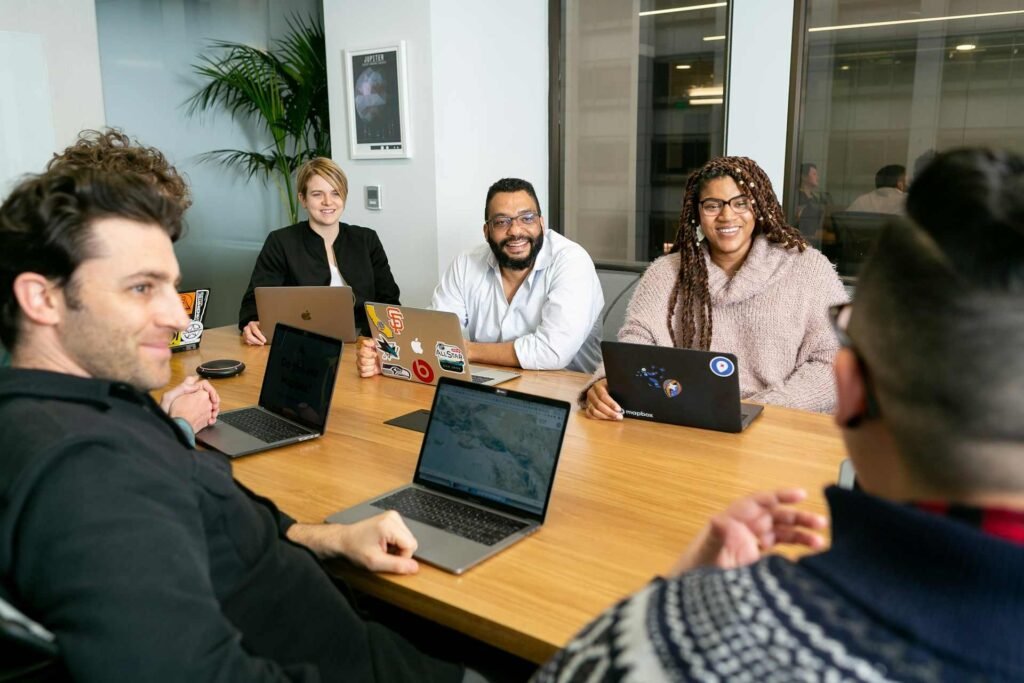
There’s also the visibility factor. The psychology of where you sit in a room operates partly on who can see you easily, and who you can see easily. If you’re tucked in a corner or blocked by a laptop stand or a particularly unfortunate centerpiece, you’re working against yourself before you even open your mouth. Contrast that with a seat where you naturally hold the sightlines to most other attendees, and the dynamic shifts considerably.
This applies outside formal meetings too. How we arrange ourselves in any collaborative space, from a brainstorm session to a working lunch, carries social meaning. If you’re someone who tends to feel overlooked or underestimated in group settings, paying attention to where you position yourself physically is a low-effort, high-return adjustment.
Position-by-Position Breakdown
Conference tables are where careers quietly get shaped, so let’s get specific. Here’s how each major seating position tends to play out at a standard rectangular conference table.
| Seat Position | Visibility | Perceived Authority | Best For |
|---|---|---|---|
| Head of table (short end) | Full room view | Highest | Running the meeting, presenting, closing deals |
| Flanking the head (left/right of leader) | Strong | High | Second-in-command, key contributors |
| Middle of long side | Moderate | Moderate | Active participants, collaborators |
| Corner seats | Limited | Lower-moderate | Supporting roles, note-taking, listening |
| Far end (opposite head) | Good | Moderate-high | Confident challenge, visible dissent |
| Door-adjacent | Low | Lowest | Avoid if you want to be heard |
The seat directly opposite the head of the table carries more weight than people realize. You’re not in the power seat, but you’re in direct eye contact with whoever is. In negotiations or high-stakes presentations, this can work in your favor, especially if you want to be seen as an equal rather than a subordinate.
The seats flanking the head of the table are arguably the most strategically underrated. You’re close to the center of gravity in the room without drawing the pressure of being the one nominally “in charge.” If you’re trying to make an impression on a senior leader or position yourself as a key contributor, aim for those two seats consistently.
Where to Sit Based on Your Goal
Where to sit at a business meeting really comes down to what you’re there to do. A one-size-fits-all approach misses the point, so here’s a more targeted way to think about it.
You’re presenting or leading the discussion. Take the head of the table. Not because it’s a power trip, but because that position gives you the visual access to read the room properly. You’ll catch the person in the back checking their phone, the skeptic with crossed arms, and the ally nodding along. That feedback loop makes you a better presenter in real time.
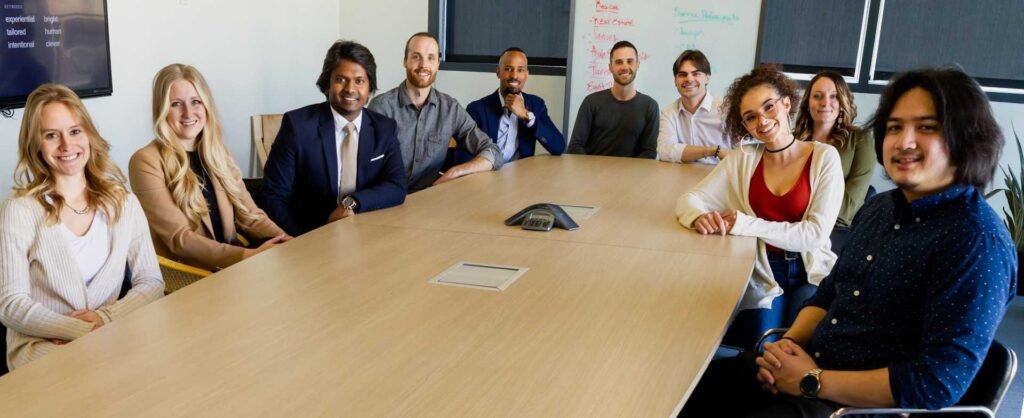
You’re pitching to a client or trying to close something. Sit adjacent to your main contact rather than directly across from them. Side-by-side seating (or a slight angle) is associated with collaboration rather than confrontation. Sitting directly across can subtly frame the conversation as adversarial, even when it isn’t. This is a small adjustment with measurable impact on how the conversation flows.
You’re new to the team and want to be noticed for the right reasons. Aim for a seat in the middle of one of the long sides. You’re visible without being presumptuous, and you’re naturally positioned to contribute to the flow of conversation rather than interrupt it from a peripheral position.
You want to listen and absorb. The corner or far-end seats aren’t bad if passive observation is your goal. Some meetings call for it. Just don’t park yourself at the door unless you’re fine being subconsciously associated with someone who’s halfway out of it.
Round Tables, Boardrooms, and the King Arthur Effect
The round table wasn’t just a medieval aesthetic choice. King Arthur specifically designed it to eliminate hierarchy, positioning all knights as equal. Modern small-group research has confirmed that circular seating arrangements do produce more balanced participation, with fewer dominant voices emerging compared to rectangular configurations.
This is useful information for meeting organizers. If the goal of your next session is genuine brainstorming or cross-functional input where you want everyone’s voice weighted equally, a round or oval table is structurally better suited to that outcome than a traditional boardroom rectangle. The format shapes the dynamic before anyone says a word.
Conversely, if you need decisiveness, clear accountability, and an obvious leader in the room, rectangular is the way to go.
Related article: Types of Desk Shapes Explained
The Environmental Variables
Beyond table shape, the room itself introduces variables that most people never consciously account for.
Lighting. Seats near windows can look appealing but leave you backlit during video calls or face-to-face discussions, turning you into a silhouette. If the meeting involves any screen-sharing or hybrid attendance, take a moment to assess the light before committing. A warm, well-lit position works in your favor both in person and on camera. For the times you’re running hybrid meetings from your own desk, a lamp designed for video calls makes a noticeable difference in how you’re perceived on screen.
Acoustics. Seats closer to HVAC vents, doors, or open plan office noise carry a hidden tax: you’ll struggle to hear and be heard. In rooms with soft furnishings and some acoustic treatment, this matters less.
Related article: How to Reduce Echo in Your Office
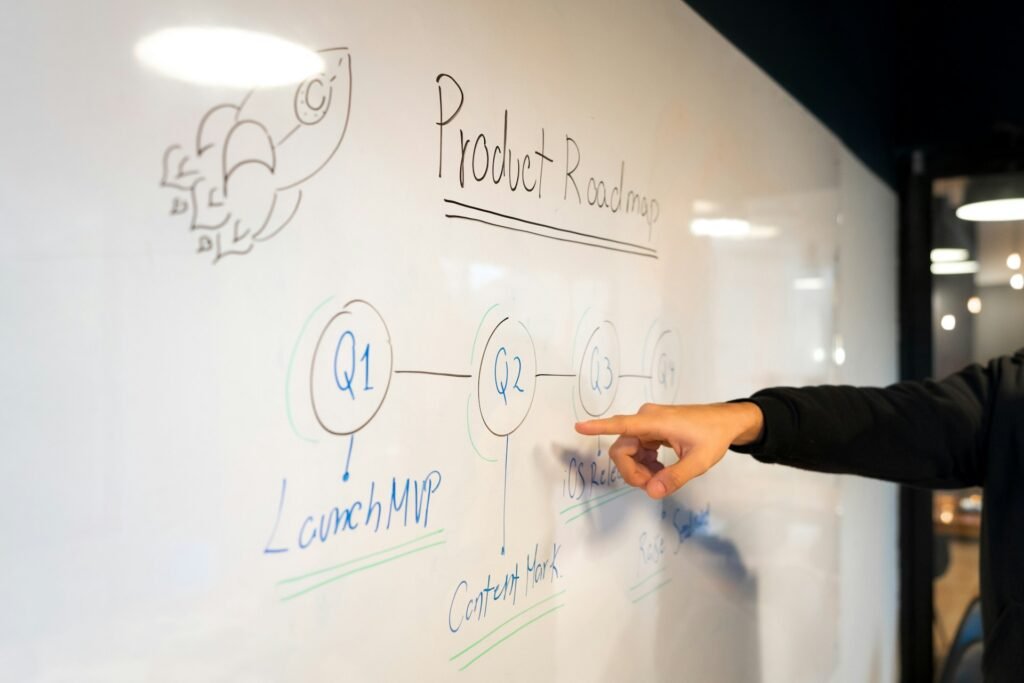
Screen and whiteboard visibility. If a presentation is happening, always know where the display is before you pick a seat. Being in a position where you have to crane your neck or shift your chair repeatedly signals disengagement, even if you’re paying close attention.
Temperature. Conference rooms are famously terrible at thermal regulation. Seats near vents or exterior walls can be noticeably colder, and research consistently links ambient temperature with cognitive performance and meeting engagement. If you tend to run cold, avoid the exterior wall seats in winter months or come prepared.
Virtual Meetings: Does “Where You Sit” Still Apply?
Sort of, yes. In a video call, your physical seat determines your background, your lighting, and your framing, all of which have a measurable effect on how you’re perceived.
So the virtual equivalent of “where to sit” is really “how to frame yourself.” Centered in the shot, eye-level camera, light source in front of you, neutral or tidy background. These are the video call equivalent of taking the right seat at the conference table.
FAQ
Wrapping Up
Nobody’s suggesting you arrive at meetings thirty minutes early to stake out the prime chair like it’s a beach towel situation. But bringing a little awareness to seating choices costs nothing and shifts how meetings go for you over time. Whether you’re trying to contribute more, be taken more seriously, or just stop feeling invisible in rooms where decisions get made, the seat you land in is a useful lever.
Next time you walk into a conference room, take two extra seconds to scan the table. Who’s sitting where, where’s the light, where’s the screen, who do you most need to be visible to? Make a choice rather than just a landing. Small intentional shifts tend to compound nicely over a career.
Looking for more? Check out our work environment category for more articles and guides that may interest you!
Featured image credit: Photo by Christina @ wocintechchat M on Unsplash
This content is for informational purposes only. Please verify current information directly on the retailer’s site before purchasing.
References:
Byun G, Choi Y, Foo D, Stewart R, Song Y, Son JY, Heo S, Ning X, Clark C, Kim H, Michelle Choi H, Kim S, Kim SY, Burrows K, Lee JT, Deziel NC, Bell ML. Effects of ambient temperature on mental and neurological conditions in older adults: A systematic review and meta-analysis. Environ Int. 2024 Dec;194:109166. https://doi.org/10.1016/j.envint.2024.109166
Greenberg, J. (1976). The Role of Seating Position in Group Interaction: A Review, with Applications for Group Trainers. Group & Organization Studies, 1(3), 310-327. https://doi.org/10.1177/105960117600100306
Howells, L. T., & Becker, S. W. (1962). “Seating arrangement and leadership emergence”: Ettatum. The Journal of Abnormal and Social Psychology, 65(3), 202. https://doi.org/10.1037/h0039670
Lim, Chaeyun, Virtual Meeting Engagement: Development and Validation of Virtual Meeting Engagement Scale (Vmes) to Understand Technology-Mediated Meetings. https://dx.doi.org/10.2139/ssrn.4726835
Lott, D. F., & Sommer, R. (1967). Seating arrangements and status. Journal of Personality and Social Psychology, 7(1, Pt.1), 90–95. https://doi.org/10.1037/h0024925
Mckenna, D. (2021). Setting the stage: Takeaways from our research on committee seating arrangements. https://www.publicgov.co.uk/2021/05/05/setting-stage-takeaways-research-committee-seating-arrangements/
Morris, J. (2018). The Effects of Seating Arrangements on Small Group Leadership Emergence. https://hilo.hawaii.edu/campuscenter/hohonu/volumes/documents/TheEffectsofSeatingArrangementsonSmallGroupLeadershipEmergence.pdf
Seet HAA, Tan E, Rajalingam P. Effect of Seating Arrangement on Class Engagement in Team-based Learning: a Quasi-Experimental Study. Med Sci Educ. 2022 Jan 9;32(1):229-237. https://doi.org/10.1007/s40670-021-01469-7
Sommer, Robert. (1961). Leadership and Group Geography. Sociometry, 24(1), 499- 510.
Terada Y (2025). Research-Based Tips for Optimal Seating Arrangements. https://www.edutopia.org/article/research-based-tips-for-optimal-seating-arrangements/
Last reviewed and edited on 09.03.2026